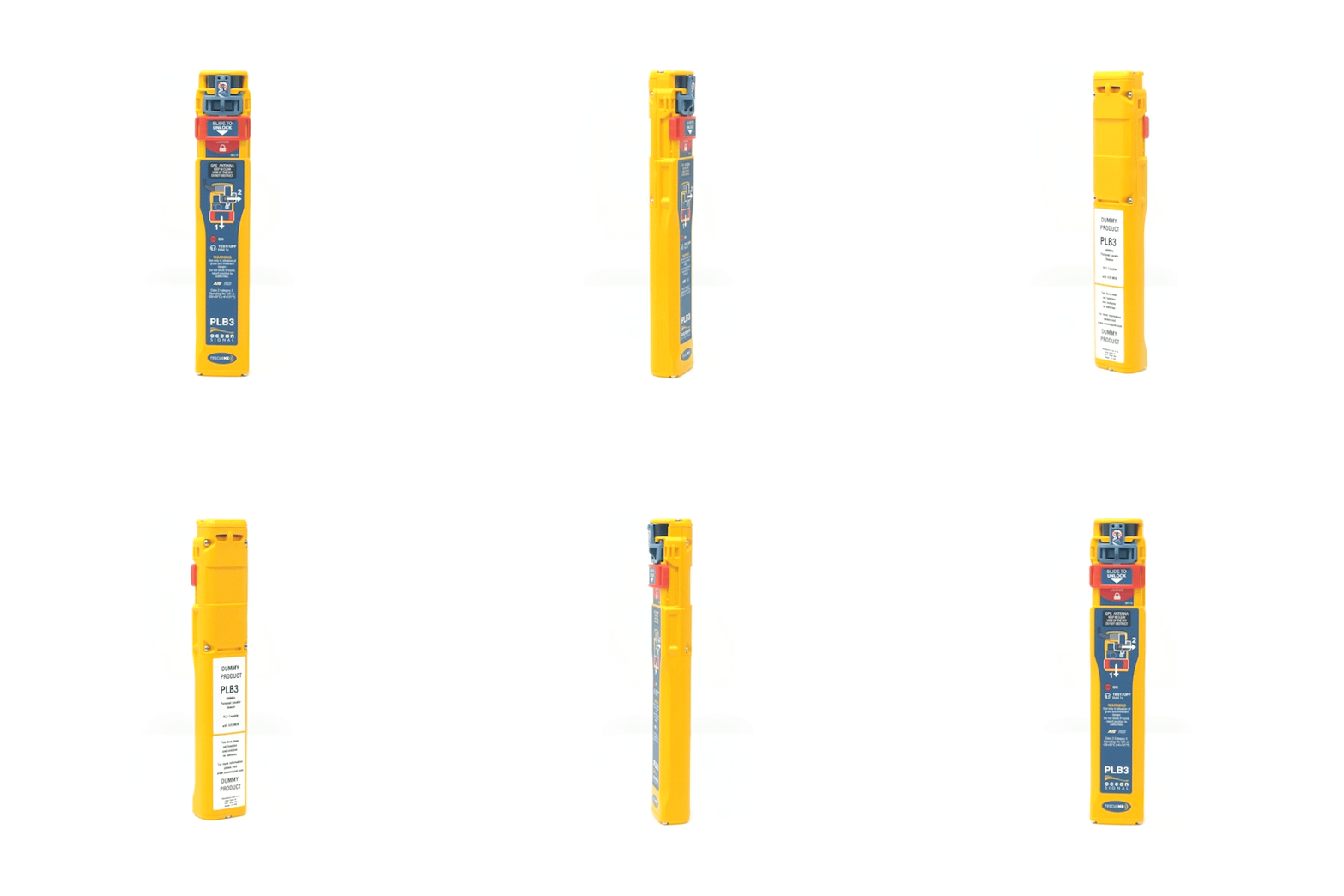
OceanSignal RescueME PLB3 with AIS Personal Locator Beacon
$62.7
$114.11
Ocean Signal’s RescueME PLB3 incorporates Automatic Identification System (AIS) functionality, Return Link Service (RLS) technology, and Near Field Communication (NFC) capabilities in one 406 MHz Personal Locator Beacon (PLB), the new Ocean Signal rescueME PLB3 represents a significant step forward in the evolution of PLB’s. The merging of 406 MHz and AIS distress messaging effectively pairs both global and local rescue, thereby maximizing access to the most effective rescue resources available. In addition, NFC capability provides users with the world’s first smartphone connected PLB and the all-new Return Link Service feature provides users with the comfort in knowing that their distress message has been received and their location detected by worldwide Search and Rescue personnel. As a leading innovator in life-saving products for both professional and recreational use, Ocean Signal is proud to offer the PLB3 AIS Personal Locator Beacon. As the world’s FIRST PLB with AIS and the world’s FIRST PLB to include NFC and mobile app, there’s no need to justify why the PLB3 should be your FIRST choice. SKU: 732S-03668 The Award Winning Ocean Signal rescueME PLB3 AIS* Personal Locator Beacon, has a free mobile app. The PLB3 transmits on the worldwide Cospas Sarsat satellite system which includes 3 different constellations to ensure your 406 MHz distress signal immediately reaches the global network of Search and Rescue teams with your location accurate to within 100 meters. With multiple levels of integrated signalling technology including 406 MHz and GNSS (GPS, Galileo, Glonass) positioning, the PLB3 also transmits a 121.5 MHz homing signal which guides Search and Rescue services to the beacon’s current location when they arrive on the scene, as the beacon may have drifted from the originally transmitted position. The addition of AIS (Automatic Identification System) transmissions means the PLB3 AIS Personal Locator Beacon simultaneously alerts all vessels equipped with AIS transponders within the VHF radio range of the PLB’s distress position. This greatly increases both the likelihood and speed of rescue since nearby vessels receive the alerts. Immediately upon deployment of the beacon an AIS Safety Message or MOB Alarm with the beacon’s MMSI and location is presented on any AIS screen within range. This makes it easy for nearby vessels to home in on the beacon since it is an active AIS target on their screens. The PLB3 will light the way as rescuer arrive on scene with both a white visible strobe and infrared strobe providing rescuers with the visual reference they need during nighttime or other low visibility rescue operations. Features: No Subscription Required 406 MHz Cospas Sarsat Distress Signal (MEOSAR Compatible) 121.5 MHz Local Homing Signal AIS (Automatic Identification System) Locating Signal Smartphone connectivity via NFC (Near Field Communication) Free Ocean Signal Beacon Mobile App (IOS and Android) Return Link Service (RLS) Functionality GNSS via GPS and Galileo Satellites Strobe and Infrared Strobe Light Global Coverage Simple PFD attachment Designed to Integrate with common Inflatable PFDs Multifunction Clip System Included Small and lightweight Battery Life: 6 years from date of manufacture or 5 years after the beacon is placed into service. Over 24 hours Operational Life Smartphone Connectivity utilizing Near Field Communication (NFC) The integration of NFC technology provides users with the ability to conveniently access beacon data from their mobile phone. The simple act of placing a phone near the beacon automatically opens the Ocean Signal Product App and provides access to a wealth of usage data including current battery life, number of self-tests completed, number of GNSS tests completed, and if applicable, the amount of time the beacon has been activated. Detailed information on each self-test and GNSS test performed by the beacon is also available if desired. For each successful GNSS test, users can view a map showing exactly where the test was performed, the date and time of the test, the time it took the beacon to get a fix on your GNSS coordinates, the number of satellites the beacon used to obtain that fix, and the accuracy of the location. Return Link Service Return Link Service or RLS functionality works when Search and Rescue send a signal back through the Galileo satellite network to confirm to the beacon user that their distress message has been received and their location detected. User confirmation is distinctly indicated by a flashing blue light on the PLB3. In addition to including a comprehensive feature set, the PLB3 AIS Personal Locator Beacon is built for comfort. Enjoy the peace of mind in knowing that your distress message has been successfully delivered and that help is on the way. Life Jacket Integration The PLB3 is designed to install within a life jacket and activate upon inflation of the jacket (semi-automatic). Installation is made simple using the included oral inflation tube clip to attach the PLB3 to the life jacket with a ribbon connected around the bladder of the life jacket. Once correctly installed, the action of the life jacket inflating triggers deployment of the antenna and activation of the beacon. Users not wishing to install the PLB3 within a life jacket have the option to utilize the included webbing clip to attach the beacon to an appropriately sized belt or the webbing of an inherently buoyant life jacket. AIS (Automatic Identification System) overview The Automatic Identification System (AIS) is a short-range coastal tracking system currently used on ships. It was developed to provide identification and positioning information to both vessels and shore stations. *AIS (Automatic Identification System) is the mariner’s most significant development in navigation safety since the introduction of radar. This is a digital positional awareness system operating in the Very High Frequency (VHF) maritime band. Its purpose is to help identify ships, assist in target tracking, assist in search and rescue operation, simplify information exchange and provide additional information to assist situational awareness (International Maritime Organization (IMO), A 29/Res.1106). Originally developed as a collision avoidance tool to enable commercial vessels to ‘see’ each other more clearly in all conditions and improve the helmsman’s information about his surrounding environment.